Loading...
Searching...
No Matches
Classes |
Public Types |
Public Member Functions |
Protected Member Functions |
Static Protected Member Functions |
Protected Attributes |
Static Private Member Functions |
List of all members
MayaFlux::Nodes::NodeNetwork Class Referenceabstract
Abstract base class for structured collections of nodes with defined relationships. More...
#include <NodeNetwork.hpp>
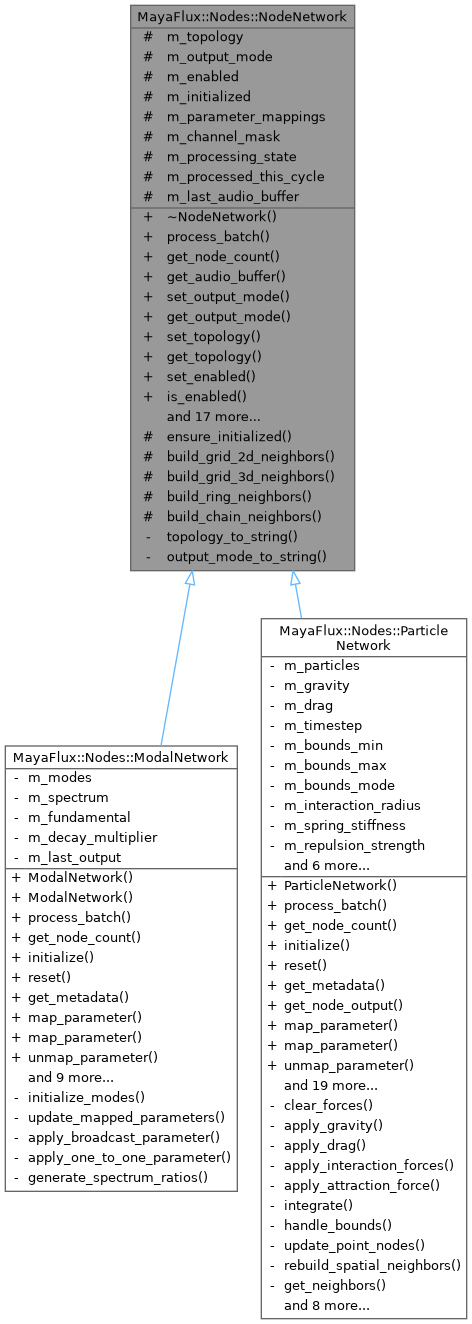
 Inheritance diagram for MayaFlux::Nodes::NodeNetwork:
 Collaboration diagram for MayaFlux::Nodes::NodeNetwork:
Classes | |
| struct | ParameterMapping |
Public Types | |
| enum class | Topology : uint8_t { INDEPENDENT , CHAIN , RING , GRID_2D , GRID_3D , SPATIAL , CUSTOM } |
| Defines the structural relationships between nodes in the network. More... | |
| enum class | OutputMode : uint8_t { NONE , AUDIO_SINK , GRAPHICS_BIND , CUSTOM } |
| Defines how the network's computational results are exposed. More... | |
| enum class | MappingMode : uint8_t { BROADCAST , ONE_TO_ONE } |
| Defines how nodes map to external entities (e.g., audio channels, graphics objects) More... | |
Public Member Functions | |
| virtual | ~NodeNetwork ()=default |
| virtual void | process_batch (unsigned int num_samples)=0 |
| Process the network for the given number of samples. | |
| virtual size_t | get_node_count () const =0 |
| Get the number of nodes in the network. | |
| virtual std::optional< std::vector< double > > | get_audio_buffer () const |
| Get cached audio buffer from last process_batch() | |
| void | set_output_mode (OutputMode mode) |
| Set the network's output routing mode. | |
| OutputMode | get_output_mode () const |
| Get the current output routing mode. | |
| void | set_topology (Topology topology) |
| Set the network's topology. | |
| Topology | get_topology () const |
| Get the current topology. | |
| void | set_enabled (bool enabled) |
| Enable/disable the network. | |
| bool | is_enabled () const |
| Check if network is enabled. | |
| virtual std::unordered_map< std::string, std::string > | get_metadata () const |
| Get network metadata for debugging/visualization. | |
| virtual std::optional< double > | get_node_output (size_t index) const |
| Get output of specific internal node (for ONE_TO_ONE mapping) | |
| virtual void | initialize () |
| Called once before first process_batch() | |
| virtual void | reset () |
| Reset network to initial state. | |
| virtual void | map_parameter (const std::string ¶m_name, const std::shared_ptr< Node > &source, MappingMode mode=MappingMode::BROADCAST) |
| Map external node output to network parameter. | |
| virtual void | map_parameter (const std::string ¶m_name, const std::shared_ptr< NodeNetwork > &source_network) |
| Map external node network to network parameters (ONE_TO_ONE) | |
| virtual void | unmap_parameter (const std::string ¶m_name) |
| Remove parameter mapping. | |
| void | add_channel_usage (uint32_t channel_id) |
| Register network usage on a specific channel. | |
| void | remove_channel_usage (uint32_t channel_id) |
| Unregister network from a specific channel. | |
| bool | is_registered_on_channel (uint32_t channel_id) const |
| Check if network is registered on a channel. | |
| std::vector< uint32_t > | get_registered_channels () const |
| Get all channels this network is registered on. | |
| uint32_t | get_channel_mask () const |
| Get channel mask (bitfield of registered channels) | |
| void | set_channel_mask (uint32_t mask) |
| Set channel mask directly. | |
| bool | is_processed_this_cycle () const |
| Check if network has been processed this cycle (lock-free) | |
| void | mark_processing (bool processing) |
| Mark network as processing or not (lock-free) | |
| void | mark_processed (bool processed) |
| Mark network as processed this cycle (lock-free) | |
| bool | is_processing () const |
| Check if network is currently processing (lock-free) | |
Protected Member Functions | |
| void | ensure_initialized () |
| Ensure initialize() is called exactly once. | |
Static Protected Member Functions | |
| static std::unordered_map< size_t, std::vector< size_t > > | build_grid_2d_neighbors (size_t width, size_t height) |
| Build neighbor map for GRID_2D topology. | |
| static std::unordered_map< size_t, std::vector< size_t > > | build_grid_3d_neighbors (size_t width, size_t height, size_t depth) |
| Build neighbor map for GRID_3D topology. | |
| static std::unordered_map< size_t, std::vector< size_t > > | build_ring_neighbors (size_t count) |
| Build neighbor map for RING topology. | |
| static std::unordered_map< size_t, std::vector< size_t > > | build_chain_neighbors (size_t count) |
| Build neighbor map for CHAIN topology. | |
Protected Attributes | |
| Topology | m_topology = Topology::INDEPENDENT |
| OutputMode | m_output_mode = OutputMode::NONE |
| bool | m_enabled = true |
| bool | m_initialized = false |
| std::vector< ParameterMapping > | m_parameter_mappings |
| std::atomic< uint32_t > | m_channel_mask { 0 } |
| Bitfield of channels this network is registered on. | |
| std::atomic< bool > | m_processing_state { false } |
| Per-channel processing state (lock-free atomic flags) | |
| std::atomic< bool > | m_processed_this_cycle { false } |
| std::vector< double > | m_last_audio_buffer |
Static Private Member Functions | |
| static std::string | topology_to_string (Topology topo) |
| static std::string | output_mode_to_string (OutputMode mode) |
Detailed Description
Abstract base class for structured collections of nodes with defined relationships.
DESIGN PRINCIPLES:
- OWNERSHIP: Networks own their nodes exclusively. Nodes within a network cannot be independently attached to NodeGraphManager channels.
- PROCESSING: Networks are processed directly by NodeGraphManager, parallel to RootNodes. They are NOT summed through RootNode but manage their own internal processing pipeline.
- OUTPUT ROUTING: Networks explicitly declare their output mode:
- NONE: Pure internal computation (e.g., particle physics state)
- AUDIO_SINK: Contributes to audio output (aggregated samples)
- GRAPHICS_BIND: Data available for visualization (read-only)
- CUSTOM: User-defined handling via callbacks
- TOPOLOGY: Networks define relationships between nodes:
- INDEPENDENT: No inter-node connections
- CHAIN: Linear sequence (node[i] → node[i+1])
- RING: Circular (last connects to first)
- GRID_2D/3D: Spatial lattice with neighbor connections
- SPATIAL: Dynamic proximity-based relationships
- CUSTOM: Arbitrary user-defined topology
- EXTENSIBILITY: Subclasses define:
- Internal node data structure (spatial, physical, abstract)
- Interaction behavior (forces, coupling, feedback)
- Aggregation logic (how to combine node outputs)
- Initialization patterns (how to populate the network)
PHILOSOPHY:
NodeNetworks embody "structure IS content" - the relationships between nodes define emergent behavior. They bridge individual node computation with collective, coordinated behavior patterns (swarms, resonances, waveguides, recursive growth).
Networks are NOT:
- Buffers (no sequential data storage)
- Processors (no transformation pipelines)
- Simple node containers (relationships matter)
Networks ARE:
- Relational structures for coordinated node behavior
- Generators of emergent complexity from simple rules
- Cross-domain abstractions (audio, visual, control unified)
USAGE PATTERN:
// Create network via builder or subclass constructor
auto particles = std::make_shared<ParticleNetwork>(1000);
particles->set_output_mode(OutputMode::GRAPHICS_BIND);
particles->initialize_random_positions();
// Register with NodeGraphManager (NOT RootNode)
node_graph_manager->add_network(particles, ProcessingToken::VISUAL_RATE);
// NodeGraphManager calls process_batch() each frame
// Graphics nodes can read network state for visualization
auto geom = std::make_shared<NetworkGeometryNode>(particles);
@ GRAPHICS_BIND
State available for visualization (read-only)
@ VISUAL_RATE
Nodes that process at the visual frame rate.
Definition at line 77 of file NodeNetwork.hpp.
The documentation for this class was generated from the following files: